


Author: Henri E. Prasetyo¹
¹DMC Research and Development, Indonesia
The Indonesian poultry industry continues to grow rapidly as demand increases for efficient, healthy, and high-quality chicken meat. However, field challenges remain complex. Fluctuating raw material prices, performance pressure, antibiotic reduction mandates, and consumer expectations for food safety have driven the industry to seek more integrated and sustainable solutions.
One emerging paradigm addressing these issues is the holistic feed concept a feeding approach that looks beyond simple nutrient supply toward supporting the bird’s entire biological system.
Unlike conventional feed formulation, which focuses mainly on energy and protein, the holistic feed approach views feed as an integral part of the bird’s physiological ecosystem. Feed not only provides nutrients but also supports gut health, enhances metabolic efficiency, strengthens immunity, and ultimately contributes to the quality of the final meat product. This comprehensive strategy aims to balance nutrition, health, and sustainability, offering a smart solution to the demands of modern poultry production.
Beyond Energy and Protein : Toward Functional Nutrition
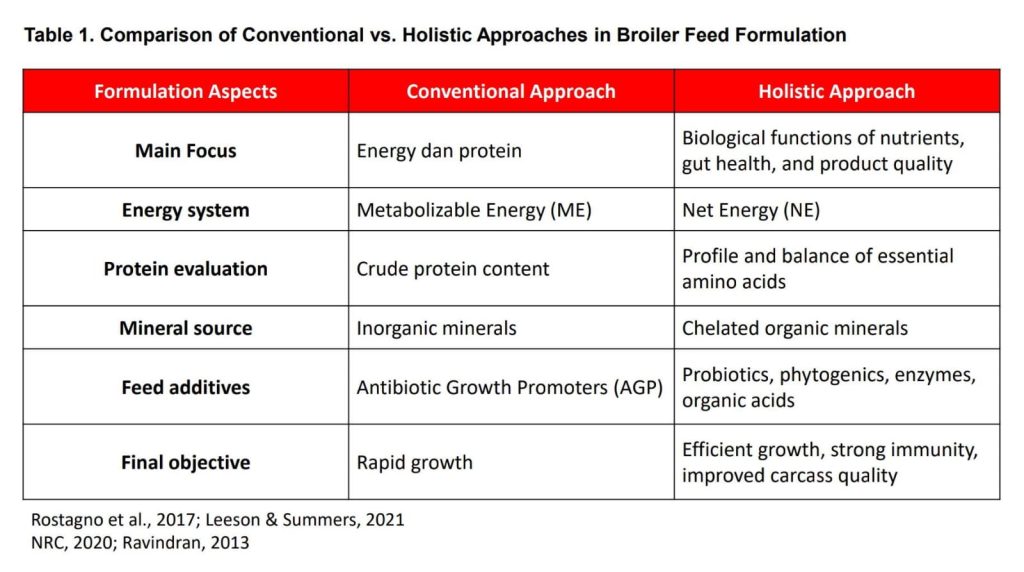
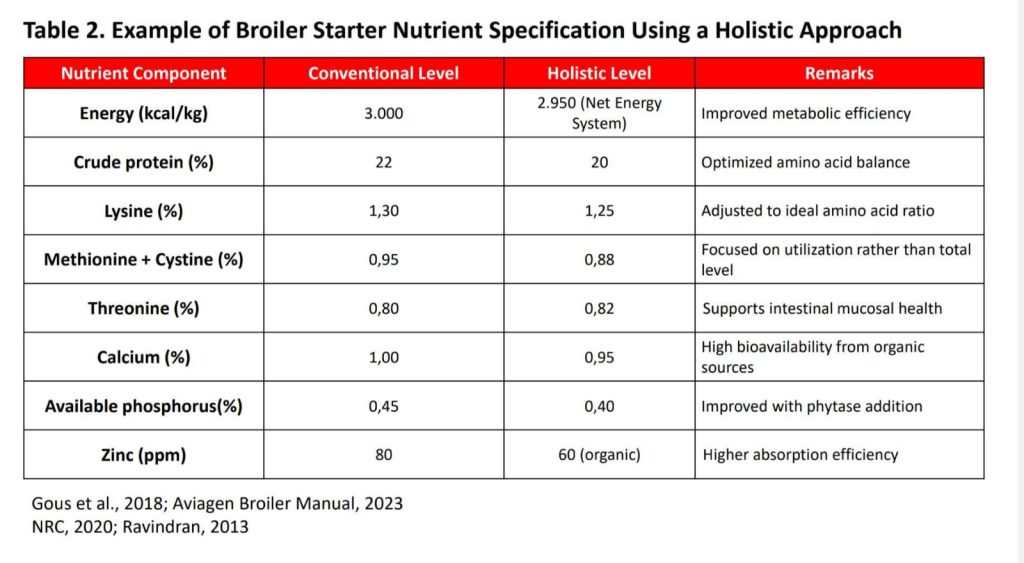
Modern feed formulation has evolved from meeting mere nutrient requirements to understanding the biological roles of nutrients in the bird’s body.
The net energy system, for example, has gained attention for providing a more accurate estimation of the energy truly available for growth, rather than just digested energy. This approach helps reduce metabolic heat loss a critical advantage for broiler production in tropical climates.
Protein formulation has also advanced significantly. In the past, nutritionists mainly focused on lysine and methionine; today, the emphasis extends to ideal amino acid balance, including threonine, valine, and tryptophan. These amino acids play essential roles in maintaining intestinal integrity, supporting immune function, and promoting efficient muscle development.
Furthermore, organic trace minerals such as zinc, manganese, and copper are increasingly incorporated due to their key roles in bone strength, skin integrity, and overall metabolic performance. This shift marks a transition from quantitative nutrition to qualitative and functional nutrition.
Feed Ingredients : More Than Just Nutrient Numbers
In a holistic feed framework, ingredients are not viewed merely as sources of energy or protein but as functional carriers. Ingredient selection must consider digestibility, stability, and safety. Two raw materials with identical crude protein values may yield very different biological responses depending on their bioavailability and digestibility.
Rapid analytical technologies such as Near-Infrared Reflectance Spectroscopy (NIRS) now play a crucial role in ensuring consistent ingredient quality. This allows nutritionists to dynamically adjust formulations to account for variability in local raw materials such as corn, rice bran, and soybean meal.
The strategic use of local resources such as coconut meal, rice bran oil, or processed cassava leaves can reduce feed costs while supporting local agricultural systems and sustainability goals. The holistic feed concept emphasizes environmentally responsible sourcing, aligning with the global shift toward sustainable and resource-efficient livestock production.
Antinutritional Factors : The Hidden Threat
Often, performance drops not because of poor formulation but due to antinutritional factors (ANFs) present in feed ingredients. Substances such as trypsin inhibitors in raw soy, phytate that binds minerals, and non-starch polysaccharides (NSP) that increase gut viscosity can severely limit nutrient absorption.
Mycotoxins such as aflatoxin or deoxynivalenol (DON) pose another significant threat, damaging the liver and suppressing immune function. A holistic feed approach employs risk-based quality control, evaluating each ingredient not only by nutrient content but also by its potential risk profile.
The strategic use of feed enzymes such as phytase, xylanase, and protease can mitigate ANFs and improve nutrient utilization. Meanwhile, modern toxin binders selectively neutralize mycotoxins without interfering with essential nutrient absorption. This integrated approach ensures feed safety and consistency, critical for maintaining broiler health and performance.
Functional Feed Additives : Enhancing Gut Health and Efficiency
Holistic feeding cannot be separated from the role of functional feed additives that promote gut balance and metabolic efficiency. In the era of antibiotic-free production, additives such as probiotics, prebiotics, enzymes, organic acids, and phytogenics have become the forefront of nutritional innovation.
Probiotics like Bacillus subtilis help stabilize intestinal microflora, while prebiotics such as MOS (mannan oligosaccharides) and FOS (fructooligosaccharides) promote beneficial bacterial growth. Phytogenic compounds including essential oils from oregano, thyme, or ginger provide natural antioxidant and antimicrobial properties, enabling gradual replacement of antibiotic growth promoters (AGPs).
Blends of organic acids further enhance intestinal pH balance, mineral absorption, and pathogen control, particularly against E. coli and Salmonella. When combined, these additives create synergistic effects that improve gut health, optimize nutrient absorption, and strengthen the bird’s resilience to environmental stressors.
From Barn to Carcass : Tangible Field Results
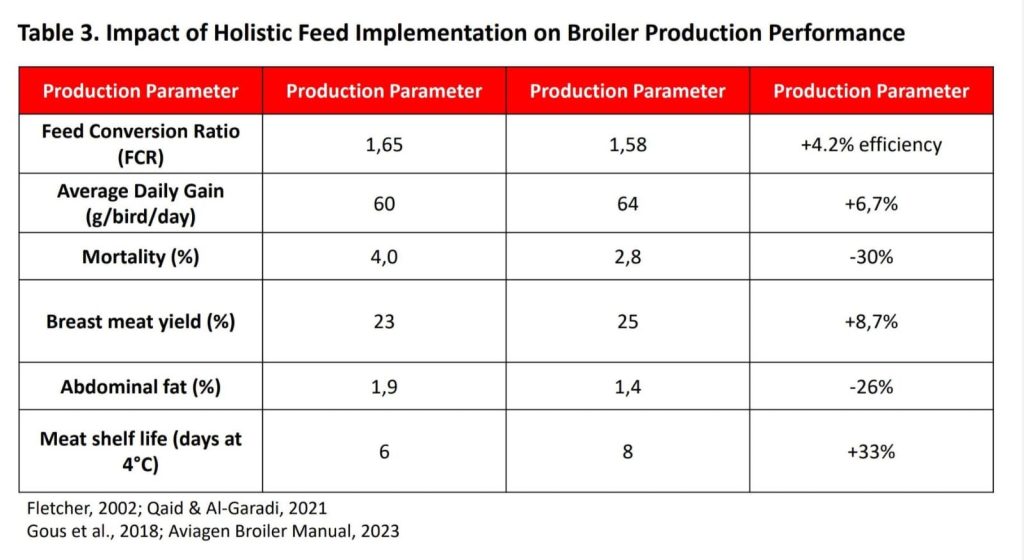
Field application of the holistic feed concept has yielded measurable improvements in production performance. Broilers show better feed conversion ratios (FCR), more uniform growth, and lower mortality rates. Carcass yields also improve, particularly in breast meat proportion and reduced abdominal fat deposition.
From a product quality standpoint, broilers fed holistic diets produce firmer, brighter meat with a more balanced fat composition. The increase in polyunsaturated fatty acids (PUFA) results in healthier meat, meeting modern consumer preferences for high-nutrient, lower-fat products. Additionally, the meat tends to have a longer shelf life, attributed to lower lipid oxidation rates a benefit both for processors and end consumers.
Comprehensive Nutrition for Sustainable Production
The holistic feed concept is more than a trend it represents a paradigm shift in modern poultry nutrition. It teaches that broiler nutrition must be viewed as an interconnected system linking feed composition, gut microbiota, physiological function, and environmental factors.
By integrating every aspect from raw material selection, antinutritional control, and functional additive application to balanced nutrient formulation producers can achieve optimal performance without compromising bird welfare or product quality.
In today’s complex poultry industry landscape, holistic feeding is not merely a technical approach but a strategic management philosophy ensuring efficiency, profitability, and sustainability for the future of Indonesia’s and the global poultry sector.
